Although Traditional Chinese Medicine (TCM) originated in China and spread throughout Asia—including Vietnam—it has a deep connection with indigenous health traditions and rituals in many countries.
In this blog, we dive deeper into Vietnamese traditions and a medicinal herb you need to know more about. But first, some background information. Within traditional Vietnamese medical practices, a distinction is made between two different branches: Thuốc Bắc and Thuốc Nam.
What is the difference between Thuốc Bắc and Thuốc Nam?
Thuốc Bắc translates to “Medicine from the North” and relies on classical Chinese herbal medicine with herbs imported from China. Thuốc Nam —“Medicine from the South”—is based on authentic, indigenous folk medicine. The practices within Medicine from the South originate from knowledge passed down through generations within tribes, communities, and families that include herbs that grow locally.
Both Thuốc Bắc and Thuốc Nam are practices that originated over 3,000 years ago and were initially passed down orally by healers who were key members of tribes and communities. They were deeply connected not only to the health of their community, but also to nature. They studied nature and knew exactly how to use the leaves, flowers, and roots growing in their immediate surroundings to improve the health of their communities. They learned how to process the herbs into tonics, teas, ointments, and plasters, but also into healthy, delicious dishes. Many Thuốc Nam herbs have become part of family recipes for better health and a warm stomach which are still cooked today.
Healthy people, and therefore a healthy community, are in my opinion the essence of TCM, Thuốc Nam, and Thuốc Bắc. Only when our world is healthy, it can be a better world.
That’s why I am sharing one of the herbs used in the ancient practice of local herbal medicine to support your health. The Honeysuckle is a simple and powerful plant that is currently blooming in Asia, Europe, and the United States.
Honeysuckle: The Gold and Silver Flower
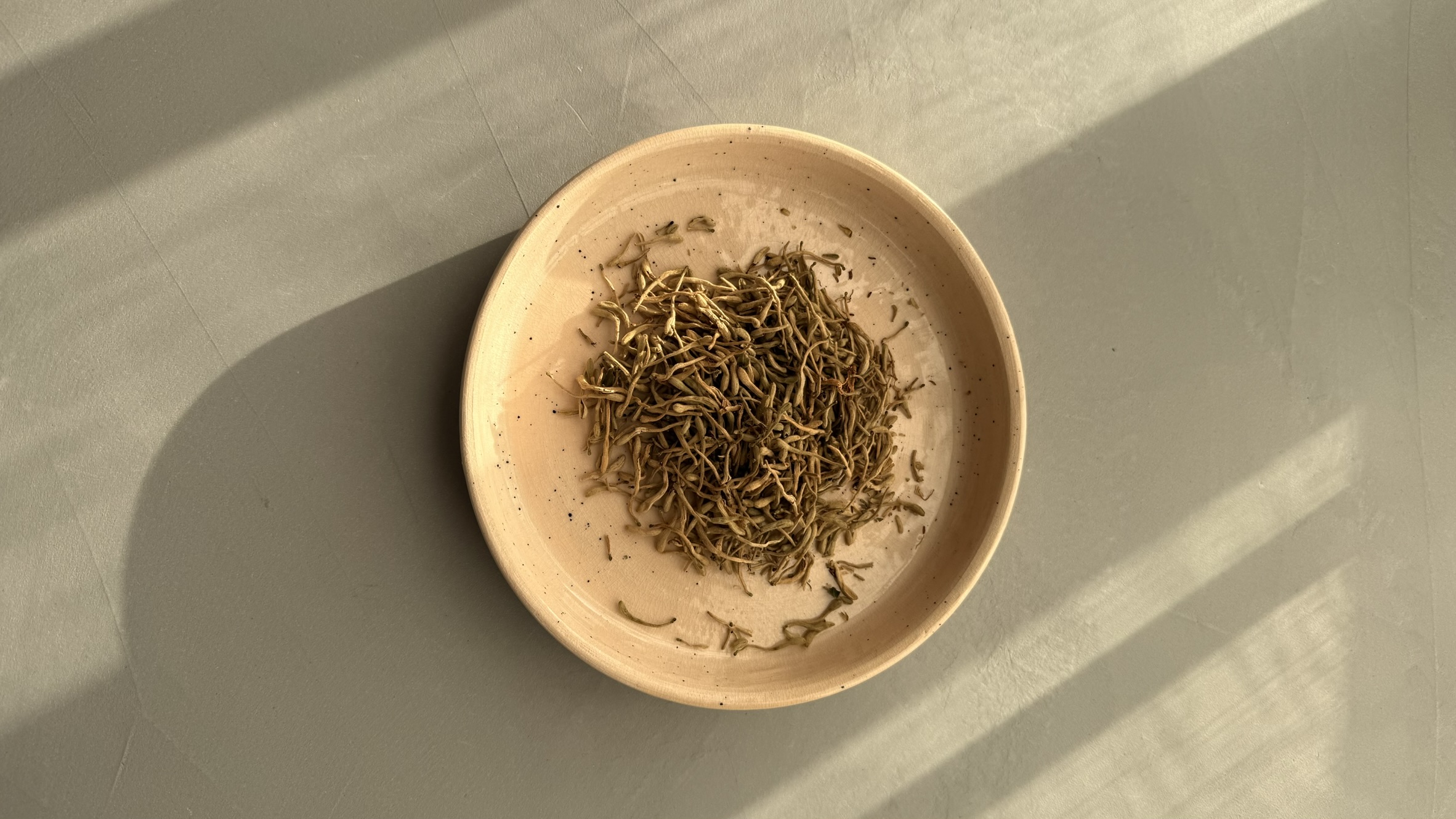
Honeysuckle, also known as Jin Yin Hua 金银花 (and Kim Ngân Hoa in Vietnamese), is a simple yet essential herb for your health. It is a prominent medicinal herb from the honeysuckle family (Caprifoliaceae). In TCM, the dried flower buds of the Lonicera japonica plant are used.
The name Jin Yin Hua literally translates to “Gold and Silver Flower”. This is because the petals open as silvery white and naturally turn golden yellow as they age. The flowers are carefully harvested in the spring or early summer, just before they fully open, to capture their maximum medicinal properties. After harvesting, the flower buds are dried in the shade and used unprocessed. The herb has a delicate, light floral scent and a pleasant, sweet taste.
The benefits of Honeysuckle According to TCM
In TCM, herbs and foods have thermal properties, such as cold, warm, and neutral. The thermal nature of honeysuckle is cold. Besides that TCM herbs act upon different meridians in the body that are connected to the TCM organs (note: this is different from the Western definition of organs). Honeysuckle affects the meridians of the Lungs, Heart, and Stomach.
Because it is connected to the Lung and Stomach meridians, it is a primary herb for clearing ‘Heat’ and ‘Toxicity’ from the body.
What is honeysuckle good for?
-
Immune system: It helps fight off the early stages of a cold (what we call Wind-Heat in TCM), such as at the onset of a sore throat or a headache.
-
Skin conditions: From a TCM perspective, honeysuckle is used to soothe heat-related conditions such as acne and cold sores.
-
Calming effect: Because it is a cooling herb, it also has a calming effect, unlike stimulating things like coffee. Therefore, it is a great drink for the evening or during stressful periods.
-
Diabetes: Research has been conducted on the honeysuckle plant (in its entirety, including the berries) which found a positive effect on type 2 diabetes (Han, Kim et al., 2015). However, more research is needed, including on the honeysuckle flower (which we use in TCM).
Honeysuckle can be a gentle yet potent natural remedy to cool the body, calm your mind, and improve your immune system.
How to use honeysuckle
The honeysuckle flower is one of the many medicinal herbs that you can easily use at home. Unlike hard roots that need to simmer for hours, these delicate flowers are perfect for a simple herbal tea:
-
Always rinse the dried flowers briefly before use.
-
Let a tablespoon (about 2-3 grams) of dried honeysuckle steep in a teapot with hot water for about 10 minutes.
-
Tip: You can beautifully combine this with white tea and other herbs for an extra soothing, cooling drink. Or pick up this tea at my clinic.
Important contraindications: Use this herb, just like all other herbs, in moderation. Because of its cold nature, you should avoid honeysuckle if you have a weak, “cold” digestive system (for example, if you are prone to diarhea or feel chronically cold). We also recommend avoiding this herb (like most TCM herbs) during pregnancy or breastfeeding and in case an allergic reaction occurs. Always consult your acupuncturist or TCM specialist to check if this herb suits your personal constitution.
Are you curious about what TCM and acupuncture can do for you? Book a session with me at my clinic in Amsterdam East.
Stay Connected
Would you like to receive clear, practical articles on hormonal health, nutrition, and TCM?
-
Newsletter: Sign up below to stay in touch.
-
Instagram: Follow me here for insights on holistic health and TCM.
Acupuncture in Amsterdam East
My clinic is located in the Eastern Docklands (Oostelijke Eilanden), between Java Island and Amsterdam Central Station.
-
Public Transport: Tram 26 and local buses stop a 5-minute walk away.
-
Car: Ample parking is available in the nearby De Loodsen or Withoedenveem parking garages.